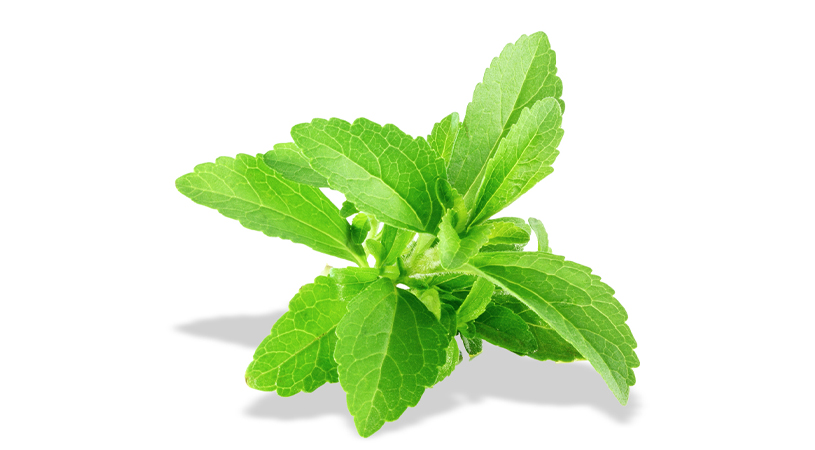
Stevia is a natural sweetener and sugar substitute derived from the leaves of the plant species Stevia rebaudiana, native to Paraguay and Brazil. The active compounds are steviol glycosides (mainly stevioside and rebaudioside), 54 which have about 50 to 300 times the sweetness of sugar, are heat-stable, pH-stable, and not fermentable. The human body does not metabolize the glycosides in stevia, so it contains zero calories as a non-nutritive sweetener. Stevia's taste has a slower onset and longer duration than that of sugar, and at high concentrations some of its extracts may have an aftertaste described as licorice-like or bitter. Stevia is used in sugar- and calorie-reduced food and beverage products as an alternative for variants with sugar. The legal status of stevia as a food additive or dietary supplement varies from country to country. In the United States, certain high-purity stevia glycoside extracts have been generally recognized as safe (GRAS) and may be lawfully marketed and added to food products, but stevia leaf and crude extracts do not have GRAS or Food and Drug Administration (FDA) approval for use in food. The European Union approved Stevia rebaudiana additives in 2011, while in Japan, stevia has been widely used as a sweetener for decades. The plant Stevia rebaudiana has been used for more than 1,500 years by the Guaraní peoples of South America, who called it ka'a he'ê ("sweet herb"). The leaves have been used traditionally for hundreds of years in both Paraguay and Brazil to sweeten local teas and medicines, and as a "sweet treat". The genus was named for the Spanish botanist and physician Pedro Jaime Esteve (Petrus James Stevus, 1500–1556) a professor of botany at the University of Valencia. In 1899, Swiss botanist Moisés Santiago Bertoni, while conducting research in eastern Paraguay, first described the plant and the sweet taste in detail. Only limited research was conducted on the topic until, in 1931, two French chemists isolated the glycosides that give stevia its sweet taste. - Quoted from Wikipedia